Costs
Reading digital customer journeys with a sceptical eye
Digital customer journeys in 2027 connect customer intent, channels, owned experiences, handoffs, service states, accessibility, evidence, economics, and fixes.
What to take away
- Map a real customer decision across channels, owned experiences, people, systems, and service outcomes.
- Reconcile conflicting sources, mark hypotheses, and label unknowns.
- Give every journey state an owner, evidence source, safeguard, recovery path, and decision threshold.
- Improve the complete service from discovery through use, support, renewal, cancellation, and recovery.
Digital customer journeys describe how a specific person pursues a goal across digital and human interactions over time. The journey includes what the person tries to accomplish, encounters, understands, decides, and receives. It may cross search, websites, apps, email, social platforms, sales, payment, fulfillment, service, renewal, and exit.
Read event paths without inventing customer intent
Google Analytics documentation on path exploration explains forward and backward exploration of recorded events and pages or screens. Preserve identity, segment, filter, date, node, and metric settings, then confirm causes with research and operational evidence.
A useful journey model combines research, operational evidence, behavioral data, and clearly marked assumptions. It is not a decorative funnel or a list of company channels.
Its purpose is to improve a customer outcome and the system behind it, not to force everyone through one sequence. That discipline shapes a digital marketing strategy, where each channel earns a defined role in the customer's path.
Choose one actor, scenario, and goal
Name the person whose journey is being studied: user, buyer, administrator, recipient, approver, member, donor, or another role. Define the scenario, trigger, goal, current alternative, constraints, expected progress, and point at which the journey begins and ends. Separate different roles when their needs and authority differ.
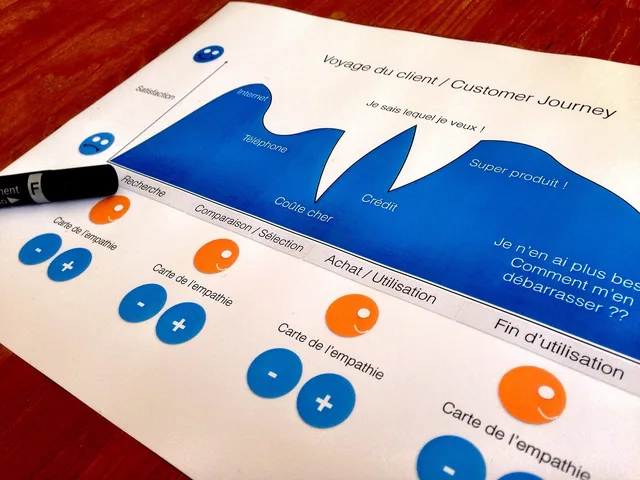
Nielsen Norman Group defines a journey map as a visualization of the process a person goes through to accomplish a goal and emphasizes a specific actor and scenario. That boundary matters. A broad map of every audience, product, and channel hides the decisions that a team must improve.
Distinguish a journey map from an event path
A journey map represents the person's goal, actions, questions, emotions, touchpoints, obstacles, and opportunities. An analytics path represents recorded screens or events under a chosen identity, time range, and configuration. A service blueprint adds the frontstage and backstage people, policies, systems, dependencies, and evidence needed to deliver the experience.
Use all three when the problem requires them. The map provides context, event data shows recorded behavior, and the blueprint exposes operational causes.
Define customer states before stages
State definitions describe what is true for the person or account: problem recognized, eligible, comparing, awaiting approval, registered, activated, fulfilled, supported, retained, renewed, cancelled, refunded, or unresolved. State should not be inferred from one page view when stronger product, transaction, or service evidence exists.
For each state, record the entry condition, exit condition, evidence source, and owner. Also record expected duration, allowable actions, exceptions, and next useful state.
A worked example shows why. Dana is a benefits administrator handling a member's enrollment at a regional health plan. Her states run: enrollment submitted, waiting on the employer file, waiting on approval, approved, active, first claim, renewed.
The shift from waiting on the employer file to waiting on approval depends on a payroll file, not on her logins. Her events show four visits during the wait, which record activity, not approval.
A state model prevents teams from sending acquisition messages after purchase or treating a support visit as a fresh sales lead. It feeds directly into digital marketing campaigns; message timing depends on where the customer stands.
Decision table
| Journey layer | Evidence | Failure question |
|---|---|---|
| Customer | Need, context, decision | Can this person benefit? |
| Experience | Observed task and usability | Can the task be completed? |
| Operation | Owner, queue, system state | Where does work stop? |
| Outcome | Value, cost, retention | Did progress endure? |
| Recovery | Error, support, correction | Can failure be repaired? |
Build the research plan and the evidence ledger
Combine interviews, contextual observation, usability sessions, diary studies, surveys with a clear purpose, search and site behavior, product events, sales notes, service contacts, transactions, cancellations, refunds, and accessibility evaluation. Sample successful, stalled, abandoned, ineligible, and dissatisfied journeys, not only loyal customers.
Write what each source can and cannot reveal. Interview memory can be incomplete. Analytics omits unrecorded actions and is shaped by identity and consent. Service notes may reflect staff categories. Surveys can attract unusual respondents. Use convergence across sources and preserve contradictions rather than averaging them away.
For every journey statement, save the actor, scenario, observation, source, date, sample, market, confidence, limitation, owner, and review date. Mark direct evidence, interpretation, and hypothesis separately. Avoid invented quotations or emotions. If the team has not researched a moment, label it unknown.
Keep customer material protected. Remove unnecessary identifiers, restrict raw recordings and notes, set retention, and document consent. Aggregate findings only when the group is large enough to protect individuals and preserve the meaning needed for the decision.
Map steps from the customer's viewpoint
For each step, record the customer's goal, action, question, information, touchpoint, channel, device, evidence, delay, effort, risk, emotion only when researched, backstage dependency, and outcome. Include loops, pauses, handoffs, alternate routes, and exits. A real journey is rarely a straight progression from awareness to purchase.
Show moments that cross digital and human service: a form followed by a call, a purchase followed by fulfillment, an app error followed by support, or a cancellation followed by a billing adjustment. The customer experiences one organization even when internal teams and vendors divide the work.
Inspect event paths carefully
Path analysis aggregates recorded events under selected identity, preference, date, segment, filter, node, and metric settings. It does not reveal uncollected offline actions, motivation, accessibility, emotion, or the cause of a repeated step.
Begin from a meaningful customer state or outcome when possible. Compare successful and unsuccessful groups, devices, markets, eligibility, and new versus returning customers. Repeated nodes may show navigation, a technical loop, or ordinary behavior; inspect sessions, tests, and customer evidence before naming the cause.
Audit information continuity
Check whether the promise, price, availability, identity, customer status, previous action, and expected next step remain consistent across channels. A person should not have to repeat verified information unnecessarily or discover material conditions only after commitment. Preserve useful context at handoffs without exposing sensitive data.
Define which system is authoritative for identity, eligibility, consent, product state, transaction, fulfillment, and service resolution. Record latency and failure behavior. When systems disagree, show the uncertainty and resolve the customer impact before optimizing a journey score.
Design accessible interactions
Test navigation, search, media, forms, authentication, payment, confirmation, and support against current accessibility requirements. Include third-party components, assistive technology, manual review, and relevant users rather than treating a generic statement as proof.
The WebAIM Million report has found automatically detected WCAG failures on more than 9 in 10 home pages in each recent year it has tested.
Include people with disabilities in appropriate research and testing. Check keyboard use, focus, contrast, readable text, zoom, speech input, screen readers, alternatives, error recovery, and time pressure. An inaccessible step is a system failure, not a customer abandonment signal.
Remove coercion and dead ends
Make choices understandable and balanced. Avoid hidden fees, preselected additions, disguised advertising, repeated pressure, obstructed cancellation, confusing privacy controls, and false urgency. The Federal Trade Commission's staff report on dark patterns describes design practices that can trick or manipulate people into choices they might not otherwise make.
Provide a clear route to decline, correct, cancel, return, complain, or reach human help where appropriate. Measure successful resolution, not just prevented exits. A short-term conversion increase created by confusion may produce refunds, complaints, distrust, and regulatory risk.
Connect the service blueprint
For each customer step, map frontstage people and interfaces, backstage work, policies, data, vendors, queues, approvals, inventory, payments, fulfillment, and evidence. Record the service promise, expected time, owner, failure modes, escalation, fallback, and recovery communication.
Look for organizational causes of customer friction: conflicting incentives, inaccessible components, duplicate databases, unclear ownership, manual re-entry, unstaffed queues, missing permissions, unreliable inventory, or policies that no channel team can change. Fix the dependency rather than adding another message around it.
Measure journey outcomes
Define completion, first value, task success, time, effort, error, recovery, fulfillment, retained value, revenue, contribution, refund, complaint, cancellation, and customer outcome. Use counts with rates and segment only when populations are interpretable. Pair quantitative trends with observed sessions and customer explanations.
Measure transitions between defined states rather than one universal funnel. Report median and distribution for time and effort, not just averages. Separate voluntary exits from technical failure, ineligibility, changed needs, or completed goals. A lower conversion may be appropriate when the journey helps unsuitable customers decline early.
Prioritize journey repairs
Score evidence strength, customer severity, number affected, accessibility impact, financial effect, strategic importance, operational risk, effort, reversibility, and dependency. Repair harm, exclusion, broken transactions, inaccurate information, and unresolved service before polishing a low-risk touchpoint.
Write the problem as an observable state: who is affected, where, under what condition, what should happen, what happens instead, and the evidence. Assign a business and technical owner. Set a target outcome and guardrails, then test the smallest change that can distinguish a useful explanation.
Run journey experiments responsibly
Predefine the hypothesis, eligible population, treatment, comparison, primary outcome, guardrails, duration, expected lag, and stopping rule. Verify accessibility, privacy, and service capacity before exposure. Do not test a known harmful or deceptive path merely to quantify its effect.
When controlled experiments are impractical, use staged rollouts, interrupted time series, matched comparisons, usability studies, and qualitative follow-up while stating limitations. Preserve negative and inconclusive results. A journey change can move effort to support or fulfillment without changing the website metric that prompted it.
Establish journey governance
- Dailyinspect broken transactions, accessibility failures, complaints, incidents, queues, and customer harm.
- Weeklyreview journey-state transitions, qualitative evidence, handoffs, experiments, and unresolved owners.
- Monthlyreconcile customer outcomes, costs, revenue, refunds, retention, support, and root-cause repairs.
- Quarterlyrevisit actors, scenarios, maps, policies, identity, consent, vendors, accessibility, and research gaps.
Maintain the journey record
Keep one record per journey: actor, scenario, goal, state definitions, evidence ledger, map, service blueprint, event configuration, accessibility review, metric dictionary, prioritized problems, owners, dates, results, and decisions. Revalidate it when the product, policy, channel, or customer changes.
Strong digital customer journeys respect the person's goal while making the delivery system observable and accountable. They connect human experience with operational causes and measurable outcomes. The map is valuable only when it directs teams toward verified repairs and makes unknowns visible.
Verify digital customer journeys before release
For digital customer journeys, the GAO evaluation design guide explains how evaluation questions, evidence needs, and design choices fit together. Use its design discipline as a check on the method.
The W3C Privacy Principles statement gives system designers a shared vocabulary for privacy and warns against shifting privacy work onto individuals. Apply that principle to the data flow behind digital customer journeys.
The GOV.UK technology selection guidance recommends choices that can change over time, preserve data control, address security risk, and include ownership cost. Those public-service rules become useful buying questions for digital customer journeys.
Apply these checks to the actual digital customer journeys workflow. Record the tested data, roles, product versions, exceptions, and approval date. Repeat the review after a material source, model, access, contract, or decision change. The sources cover separate evaluation, privacy, and operating questions, and none certifies a local implementation or a guaranteed marketing result.
Common questions
What is a digital customer journey?
It is the customer's sequence of decisions and experiences across channels, owned interfaces, people, systems, service states, and outcomes, including failure and recovery.
Is a funnel the same as a customer journey?
No. A funnel is a defined measurement sequence. A journey also includes customer context, nonlinear paths, offline activity, accessibility, emotion, service work, and recovery.
Where should journey improvement begin?
Begin at the point causing the greatest verified customer harm or lost qualified value that the organization can realistically change and measure.
Who should own the journey?
A senior owner should be accountable for the end-to-end outcome, while named teams own states, handoffs, systems, safeguards, and repair deadlines.
In this guide
- What digital customer journeys questions keep resurfacingCommon digital customer journeys questions in 2027 cover boundaries, funnels, data, research, ownership, accessibility, handoffs, failure, recovery, and reviews.
- Repairing digital customer journeys starts with a meaningful outcomeHow to improve digital customer journeys in 2027 through research, mapping, evidence, accessibility testing, handoff repair, recovery design, and outcome review.
- Digital customer journeys examples with the reasoning laid bareDigital customer journeys examples in 2027 cover software onboarding, ecommerce purchases, local services, B2B evaluation, marketplaces, subscriptions, and recovery.
- Digital customer journeys mistakes: the traps and the way around themDigital customer journeys mistakes in 2027 include channel-first maps, invented intent, inaccessible steps, weak handoffs, coercion, and ignored recovery.
- Digital customer journeys checklist: the items people skipA digital customer journeys checklist that maps frontstage and backstage work, tests accessibility, and keeps data collection justified at every handoff.
- How to use digital customer journeys benchmarks in planningDigital customer journeys benchmarks in 2027 require matched steps, populations, entry rules, time limits, accessibility, outcome maturity, costs, and baselines.
- How to pilot digital customer journeys toolsPilot digital customer journeys tools against one decision, a shared journey sample, consent withdrawal, exports, permissions, and a documented exit plan.
- Digital customer journeys best practices across channelsDigital customer journeys best practices for cross-channel planning: map goals, channel handoffs, evidence, accessibility, privacy, recovery, and outcomes.
- Reading case studies and digital customer journeys evidence: what to check before you fund a testPublished journey case studies are selected evidence, so extract the mechanism, rebuild that journey locally, and grade the proof before you fund it.
- Mixed and modeled evidence: where digital customer journeys trends headDigital customer journeys trends in 2027 include mixed evidence, AI-assisted service work, accessibility, preference testing, recovery, and journey governance.