

Strategy
Cross-channel digital marketing planning around offer terms, AI bidding, and triggers
How cross-channel digital marketing planning works: align offer terms across channels, govern AI bidding and creative, and set dated scenario triggers with owners.
What to take away
- Price, promotion, and availability terms cross channels, so plan them as one set with one start date.
- Give AI bidding and creative a named owner, guardrails, and a written rollback before launch.
- Your own transaction and first-party data beat generic benchmarks when you set channel budgets.
- Build conservative, central, and upside budgets with triggers and a dated review.
Omnichannel plans break in small places first. A discount code works in paid search and dies in an email flow. A shipping threshold updates on the site and not in a retail media feed. Each mismatch costs sales and trust, and each one is a planning failure rather than a platform failure.
Map every offer term to every channel
Start with what a customer can see: price, discount, bundle, shipping threshold, subscription rate, return window. Then list where each one appears.
Check Google Ads and Shopping feeds, Microsoft Ads, Meta and TikTok copy, and Amazon Ads and Walmart Connect placements. Then check email and SMS flows, landing pages, and checkout. Merchandising systems, Google Merchant Center, and product feeds often hold the oldest price.
Give every term a start date, an end date, and one owner per channel. One person signs off the whole set. Run an end-to-end test before launch, not after the first sale. The channel-by-channel pointers show where these gaps usually appear.
Example: a code mismatch caught in a feed
An illustrative case: a US home goods retailer launches a 15 percent code in paid search on a Monday. Email holds the same code, and the retail media feed still lists the old price.
Two prices appear in one day. The support queue fills with refund requests, and the campaign's return on ad spend looks worse than it is.
The fix is unglamorous. Add the code to the feed file, align the feed refresh with the campaign start, and compare the live landing page, the ad copy, and the feed before launch.
Govern AI bidding and creative with named steps
Platform automation now sets bids, builds audiences, and writes ad variants. Treat each use as a governed task with a written lifecycle.
Govern AI bidding and creative
- State the purpose and the decision the tool may change.
- List the inputs, including first-party segments and any uploaded customer file.
- Set guardrailsbudget caps, excluded audiences, brand-safety lists, geo limits.
- Name the reviewer and the review date for performance.
- Write the rollbackwho pauses it, how fast, and what the account reverts to.
The FTC's advertising and marketing guidance sets the claims standard that any generated variant must still meet. Keep substantiation on file for every claim.
Audience uploads carry legal weight too. A review of digital marketing trend data explains what platform-reported figures hide. California's privacy law gives consumers rights over personal information used for targeted ads, and the California Attorney General's CCPA page lists the business obligations that reach match lists.
First-party evidence beats generic benchmarks
Benchmarks describe an average advertiser. Your customers are not average. Interviews, campaign tests, service records, lost reasons, and renewal behavior give sharper inputs than a market report.
Marketing mix modeling can combine those inputs into channel contribution estimates. Treat the result as a range, then re-fit when the channel mix changes or a platform alters its attribution window.
Retail media rewrites the budget split
Retail media moved from a test line to a standing item for US brands. Retail media networks sell placements tied to purchase data, so audiences are narrow and cost per click often runs above social.
Rising costs push planners to compare retail media with paid search on incremental sales instead of last-click return. Where future digital marketing trends point helps frame which shifts deserve a budget line in 2027.
Scenario planning with triggers and dates
Point forecasts break when costs, demand, or platform rules move. Build three budgets and write the trigger for each.
Conservative: cut retail media 20 percent if cost per acquisition rises two weeks running. Central: hold the mix and shift 10 percent to email if click rates fall. Upside: add paid search budget if return on ad spend holds above target for 14 days.
Pre-authorize the small moves so nobody waits for a meeting. Keep the large ones behind a dated review.
The cross-channel signal register
| Signal | Evidence to monitor | Bounded response |
|---|---|---|
| Offer terms | Feed versus landing page mismatches | Fix the feed, delay launch |
| AI bidding | Spend shifts, errors, overrides | Pause and revert to prior settings |
| Retail media cost | Cost per click, incremental sales | Reallocate in 10 percent steps |
| First-party segments | Match rates, opt-outs, complaints | Refresh consent, re-check the list |
| Measurement | Platform numbers versus finance | Reconcile before budget review |
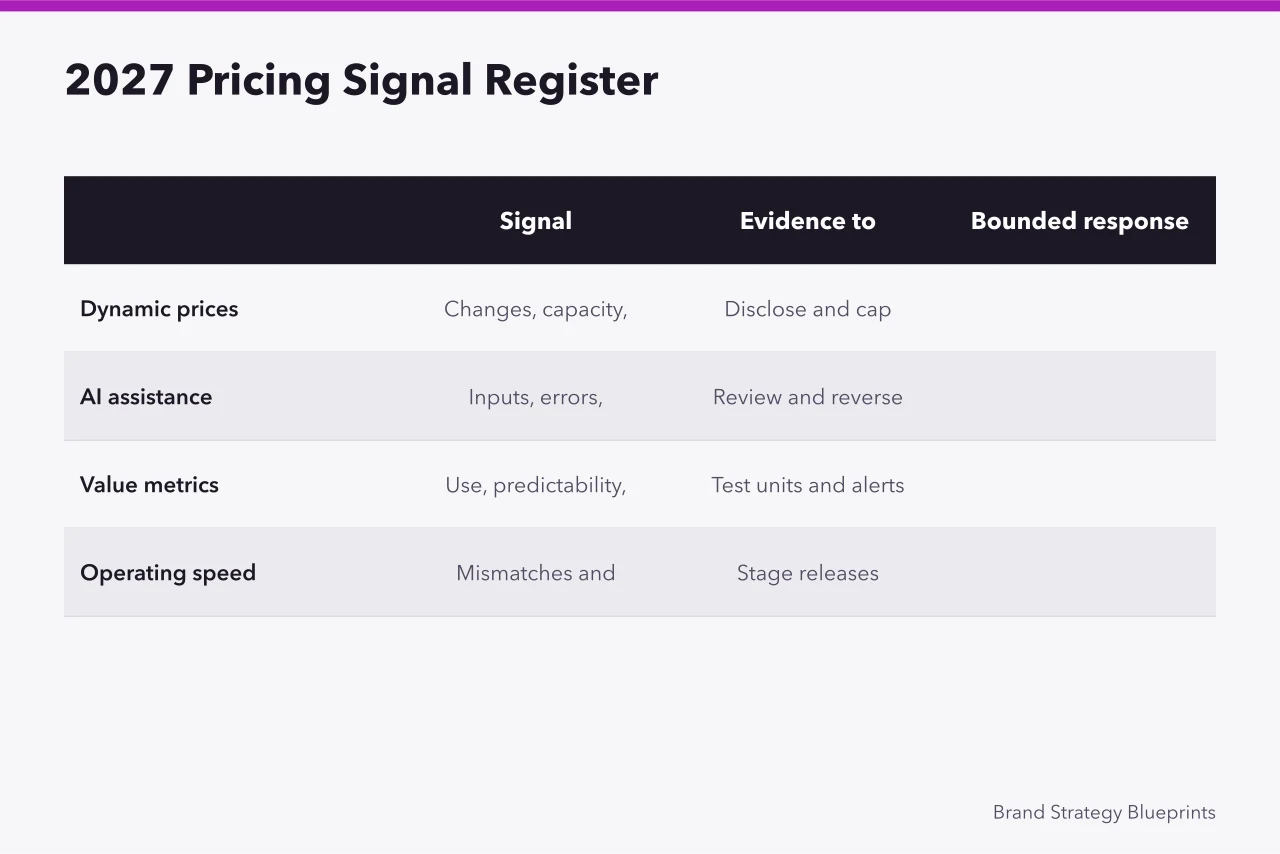
Keep a dated watchlist beside the table. Log the source, the observation date, the affected decision, confidence, the owner, the next review, and the rollback. Note which digital marketing trend drivers sit behind each number.
Common questions
Should every channel show the same price?
Not always. State law, retailer contracts, and platform rules differ, so some channels must differ. Every visible difference needs a written reason and a clear disclosure.
Can AI tools set bids without a person watching?
They can run inside the guardrails you set. A person still owns the budget cap, the excluded audiences, and the decision to pause.
How often should the watchlist be reviewed?
Match the cadence to the speed of the signal. Retail media costs may need weekly checks, while brand and legal terms can wait for a quarterly pass.